| Fundamentals of Statistics contains material of various lectures and courses of H. Lohninger on statistics, data analysis and chemometrics......click here for more. |

|

Home  Math Background Probability Conditional Probability Math Background Probability Conditional Probability |
|||||
| See also: Bayesian rule, independent events |   |
||||
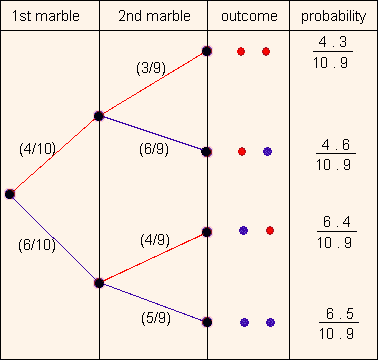
Conditional ProbabilityA conditional probability is defined as the probability of an event, given that another event has occurred. This means that the probability for event A is effected by event B. Formally, a conditional probability is depicted as P(A | B) (read: the probability of the event A under the condition that event B occurred).
The calculation of the conditional probability P(A | B) involves two steps. First we have to realize that the fact that event B occurred reduces the sample space, to the sample points of B. This applies to the whole sample space which is now B and also the sample space of A. Only the sample points of event A that also belong to event B can occur thereafter; these are the sample points of the intersection of A and B. Since the probability is the ratio of the number of sample points of an event to the total number of sample points, the conditional probability is: P(A | B) = P(A This is true under the condition that P(B) is not equal to zero. The
equation adjusts the probability of A Intersection of eventsThe probability of an intersection of events is calculated by the multiplicative rule, which makes use of conditional probabilities. We simply re-arrange the equation for the conditional probability
P(B| A) = P(A
P(A
|
|||||
| Home Math Background Probability Conditional Probability |
|
||||
 B) / P(B)
 P(B|A)