| Fundamentals of Statistics contains material of various lectures and courses of H. Lohninger on statistics, data analysis and chemometrics......click here for more. |

|

Home  Bivariate Data Time Series Models for Time Series ARIMA Models Bivariate Data Time Series Models for Time Series ARIMA Models |
|
| See also: model finding, establishing ARIMA models |   |
Time Series - Definition of ARIMA ModelsARIMA (auto-regressive integrated moving average) models establish a powerful class of models which can be applied to many real time series. ARIMA models are based on three parts: (1) an autoregressive part, (2) a contribution from a moving average, and (3) a part involving the first derivative of the time series: The auto-regressive part (AR) of the model has its origin in the theory that individual values of time series can be described by linear models based on preceding observations. For instance: x(t) = 3 x(t-1) - 4 x(t-2). The general formula for describing AR[p]-models (auto-regressive models) is:
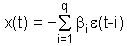
The consideration leading to moving average models (MA models) is that time series values can be expressed as being dependent on the preceding estimation errors. Past estimation or forecasting errors are taken into account when estimating the next time series value. The difference between the estimation x(t) and the actually observed value x(t) is denoted ε(t). For instance: x(t) = 3 ε(t-1) - 4 ε(t-2). The general description of MA[q]-models is:
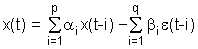
When combining both AR and MA models, ARMA models are obtained. In general, forecasting with an ARMA[p,q]-model is described using the following equation:
After additional differentiation of the
time series, and integrating it after application of the model,
one speaks of ARIMA models. They are used when trend filtering is required.
The parameter d of the ARIMA[p,d,q]-model determines the number of differentiation
steps.
Then, a suitable ARMA[p,q] model is fitted to the resulting series. Finally, the estimated forecasts have to be integrated d times. |
|
| Home Bivariate Data Time Series Models for Time Series ARIMA Models |
|